My wife loves wheat beers. When I say she loves them, I don't think that really does her love for wheat beer justice. She really loves wheat beer.
At least a couple times a year, I brew a wheat beer for her. In August, I wanted to get a wheat beer fermenting for her, since we were running dangerously low on homebrew. I decided to do an extract for the simplicity and because I was doing it during the week, it's much quicker and easier to cook and clean up.
Showing posts with label brewing. Show all posts
Showing posts with label brewing. Show all posts
Saturday, October 16, 2010


Sunday, April 25, 2010
I am the Cheeseman!
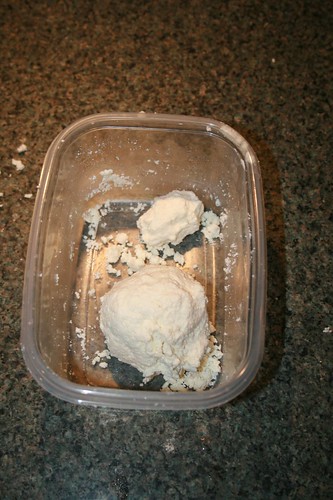
That title may be a little premature. But I hope to be the cheeseman soon. Last year my wife got me a cheese making kit. I made a couple batches of mozzarella that did not turn out as expected.
 Oh sure, it tasted like tasted like fresh mozzarella and it melted on pizza pretty similar to mozzarella, but it sure didn't look or have the consistency of mozzarella. It was more like feta in those regards.
Well, after a couple tries with the same result, I decided to contact Leeners (cheese kit makers) to see what they can recommend. Their recommendations were better straining of the whey and using non-homogenized milk.
That's all fine and dandy, but I hadn't found non-homogenized milk and I'd gotten busy, so I had not yet gone back to trying to make cheese.
That's when my lovely and fun-filled wife found that a local restaurant, The Traffic Jam and Snug, was doing a cheese making workshop and she signed us up!
Well, after a couple tries with the same result, I decided to contact Leeners (cheese kit makers) to see what they can recommend. Their recommendations were better straining of the whey and using non-homogenized milk.
That's all fine and dandy, but I hadn't found non-homogenized milk and I'd gotten busy, so I had not yet gone back to trying to make cheese.
That's when my lovely and fun-filled wife found that a local restaurant, The Traffic Jam and Snug, was doing a cheese making workshop and she signed us up!
Saturday, April 24, 2010
ESB on tap!

In March, we took on an ESB that has turned out terrific (we also did a pilsner at the same time that is ok, but not outstanding). Actually, we brewed a double batch of the ESB (one for Pete, one for me) and we decided that one of these we would dry hop with extra hops (more on that in a moment). We have been doing extract brewing, simply because its easier and faster and I'm kind of lazy.
Wednesday, February 25, 2009
When is Bad Branding Good?

On Monday, Detroit's NPR station had a story about one of the terrific Michigan microbreweries, Michigan Brewing Company in Webberville. They are bidding on a new contract to produce and sell a new beer for ... ugh... Kid Rock. As Rex Halfpenny of the Michigan Beer Guide points out, these kind of celebrity brews are a bit of a folly: "Remember Billy Beer, capitalizing on a past president? There’s been Grateful Dead beer, sports stars, Lenny Bruce, Thelonius Monk, Cole Porter... Elvira had a beer." But hopefully Bobby Mason (owner of Michigan Brewing Company) gets that this celebrity brews won't be his golden goose, but the contract may work to finance expansion. Especially thanks to Michigan providing tax breaks that will allow Mason to "invest about seven million dollars to buy the equipment and hire the people [160 people] he needs to brew the beer at his 76-thousand square foot facility."
Here's a link to the audio of the story

This is interesting (and perhaps good) way to finance expansion, if (and this is a big, fat, bold if) he's got an outstanding plan in place to capitalize on this publicity stunt. Because let's face it, that's all this is. It's got branding implications, but its publicity. The contract may be big enough to build the brewery and sustain it for a year or two, but what then? Does Mason have a plan to leverage this publicity to increase distribution or increase awareness? Will the folks pounding the Kid Rock Beer really make the move to another MBC beer?
I hope so, but even more, I hope Mason has a plan and not just a hope.
Photo (c): CelebrityRoyale.com
Tuesday, November 18, 2008
Keeping your market small
I brewed another batch of beer on Sunday. This time I decided to do a stout for the winter. I love the process of brewing beer, but the experience of buying the supplies was yet again very, very annoying.
First off, I do not care for the homebrew stores that are closest to me. I do not care for them at all. They are dirty, have terrible customer service, and are difficult to navigate. So, my expectations going into the experience were low. Very low, actually, because I called ahead to find out that they did not have everything I needed. The only store that had everything was over an hour drive away. I decided not to make the drive and set out for the store closest to me prepared for disappointment.
I my expectations were actually exceeded. Here's what I don't get:
And that was all just from one visit.
Ok, so I recognize that this particular shop is probably particularly bad. But having been to 5 different shops around the Detroit area, I can tell you that this is the norm, not the exception. Most people will say something like "Oh, its because homebrewers are such a small market" or "its just not viable as a standalone business in this market."
Sure that may be, but with "service" like this, is there really any question why?

First off, I do not care for the homebrew stores that are closest to me. I do not care for them at all. They are dirty, have terrible customer service, and are difficult to navigate. So, my expectations going into the experience were low. Very low, actually, because I called ahead to find out that they did not have everything I needed. The only store that had everything was over an hour drive away. I decided not to make the drive and set out for the store closest to me prepared for disappointment.
I my expectations were actually exceeded. Here's what I don't get:
- I don't get why they can't just simply sweep the floor. Buying grains means there are grains on the floor. Simply sweeping a few times a day would do wonders. Perhaps this is too much to ask, but I don't think so, since the guy behind the counter was watching videos online at the counter until I interrupted him with a question.
- I don't get why staff can't be (even mildly) helpful. I have been brewing for about 10 years, but I'm still learning. I asked what I thought was a simple question about brewing with fruit (which I've only done once with no success) and got a response so convoluted and filled with brewer's jargon that I was in worse shape than before I asked. When I asked for further clarification, I got a big sigh and referred to a book.
- I don't get why product can't get replaced in a timely fashion. The grains sit in big tubs in this particular shop. When the grains are gone, in theory, these get replaced from the sacks of grains in stacks on the floor behind the tubs. Of the 5 types of grains I needed, I found 2 were out. When I asked for these grains, I was told that they'd restock them "soon". Their "soon" must have a different reference point than my "soon" since there was no activity in that particular direction. I found the bag for one, opened it and took what I needed, but couldn't find the other.
And that was all just from one visit.
Ok, so I recognize that this particular shop is probably particularly bad. But having been to 5 different shops around the Detroit area, I can tell you that this is the norm, not the exception. Most people will say something like "Oh, its because homebrewers are such a small market" or "its just not viable as a standalone business in this market."
Sure that may be, but with "service" like this, is there really any question why?
Thursday, October 23, 2008
The coffee wars...
Dunkin Donuts is launching a new "taste test" ad that targets Starbucks. This is brilliantly timed campaign showing the results of an independent taste test (well, paid for by Dunkin Donuts, but conducted by an independent 3rd party research company) that shows that Dunkin Donuts won in a blind test of taste.
 I say this is brilliantly timed because as the economy continues to slip into "recession" as consumers continue to tighten their belts, pricey luxuries (such as $4 coffee) is likely to be one of the items trimmed back by consumers. If Dunkin Donuts can convince consumers that their coffee is just as good, but cheaper and not an expensive luxury, then they could definitely positioned to see some nice customer conquests.
 However, as a guy who roasts his own coffee, I see a huge opportunity to make gains on the financial incentive of brewing at home. There are some other "convenience" costs (cleaning, brewing, etc.), but with some clever positioning and promotion of some of the easy to use automatic machines that make having your coffee ready in the morning (or whenever) easier and tastier than ever.
This is where the value proposition for smaller roasters will really stand out. A cup of coffee brewed at home, even accounting for cream and sugar costs about 20-25 cents. So, the accountants will be satisfied (the "bean counters!" - sorry couldn't resist). The next hurdle will be trying to get over the extra work that is involved, particularly the cleaning process. For marketers convincing people to make the switch to home-brewed coffee will have to be demonstrate how this step is easier than most may expect. There are some larger trends that are also pointing to the success of this move, particularly an increase in homebased businesses (losing access to office coffee, definitely increased my home consumption of coffee).
With that, I'm headed back to the coffee shop (aka kitchen counter) for another cup of perfectly brewed coffee.
 I say this is brilliantly timed because as the economy continues to slip into "recession" as consumers continue to tighten their belts, pricey luxuries (such as $4 coffee) is likely to be one of the items trimmed back by consumers. If Dunkin Donuts can convince consumers that their coffee is just as good, but cheaper and not an expensive luxury, then they could definitely positioned to see some nice customer conquests.However, as a guy who roasts his own coffee, I see a huge opportunity to make gains on the financial incentive of brewing at home. There are some other "convenience" costs (cleaning, brewing, etc.), but with some clever positioning and promotion of some of the easy to use automatic machines that make having your coffee ready in the morning (or whenever) easier and tastier than ever.
This is where the value proposition for smaller roasters will really stand out. A cup of coffee brewed at home, even accounting for cream and sugar costs about 20-25 cents. So, the accountants will be satisfied (the "bean counters!" - sorry couldn't resist). The next hurdle will be trying to get over the extra work that is involved, particularly the cleaning process. For marketers convincing people to make the switch to home-brewed coffee will have to be demonstrate how this step is easier than most may expect. There are some larger trends that are also pointing to the success of this move, particularly an increase in homebased businesses (losing access to office coffee, definitely increased my home consumption of coffee).
With that, I'm headed back to the coffee shop (aka kitchen counter) for another cup of perfectly brewed coffee.
Thursday, October 16, 2008
Do-It-Yourself
Yesterday, I spent some time reading about how to build a bicycle frame. Basically, I was reading how the angles, tubes sizes, etc. are all calculated and drawn out. This led me to read about how weld and how to make carbon fiber. All of this has me thinking that I need to build my own frame.
Sure, that's a nice dream, just like the brewery I'm going to build, and the solar powered coffee roaster I'll be building.
Anyway, this had me wondering what it is about these three things that really attracts me to these activities. I'm self-delusional but not so much that I believe that I ride well enough to justify a lightweight carbon fiber, high-end, mountain bike. And contrary to popular belief, I do not drink enough beer to justify building a brewery that produces a quarter barrel of beer every month.
So, why am I drawn to these? They all have in common are three things:
And with that, I better get back to tracking down where my next bike's aluminum head tube is going to come from....
Sure, that's a nice dream, just like the brewery I'm going to build, and the solar powered coffee roaster I'll be building.
Anyway, this had me wondering what it is about these three things that really attracts me to these activities. I'm self-delusional but not so much that I believe that I ride well enough to justify a lightweight carbon fiber, high-end, mountain bike. And contrary to popular belief, I do not drink enough beer to justify building a brewery that produces a quarter barrel of beer every month.
So, why am I drawn to these? They all have in common are three things:
- they are "projects" - the act of doing - setting these items up and then working the projects (building the frame or brewing the batch of beer) is what really draws me to them. The physical act of making something.
- they all very different from how I spend most of my day - they are more hands-on, compared to the research and computer work that I spend my days on
- they are social - none of these projects are projects that I can do 100% by myself. Either though learning from someone else, or just getting help in assembly, I'm going to have to bring in a friend to help.
And with that, I better get back to tracking down where my next bike's aluminum head tube is going to come from....
Monday, September 15, 2008
Brewing for Festivals
On July 30, 2008, the Michigan Senate passed a couple bills that change the rules for brewpubs in Michigan (slightly). Under the current (well, now old) rules, brewpubs could not take their beer to beer festivals because the Liquor Control Code does not permit companies with a brewpub license to sell their beer off premise. It has to be sold at the licensed property for consumption on or off premise. The new law allows a non-profit (such as Michigan Brewers Guild) to obtain a special license that will permit brewpubs to sell off premise at beer festivals.
This may seem like a somewhat obscure rule, but it should actually make a substantial difference to brew pubs when it comes to building their brand. It will have an impact in a couple different ways: first, it will give brewpubs easy access to a substantial and very targeted audience - passionate, craft beer drinkers; second, it gives brewpubs more control over their product (more on this in a moment); and finally, it should give more access to competitions for brewpubs as well.
Some of you may be thinking that you've seen brewpubs at festivals and won competitions. That's true. But, under the old rules, brewpubs had to have their beers contract brewed at a microbrewery (a different license) to participate in festivals. This means that their beer was not brewed on their equipment by their brewers. Basically, this took away control of their own product for festivals - imagine a winning beer that wasn't actually brewed by the brewer at the brewery! Crazy.
I did discover that there is another license that brewpubs could have purchased prior to this rule to be able sell product off premise:
While retail sale is an entirely different animal than a brewpub, the access to beer festivals is a substantially improved law for those brewpubs looking to increase their profile with consumer advocates.
This may seem like a somewhat obscure rule, but it should actually make a substantial difference to brew pubs when it comes to building their brand. It will have an impact in a couple different ways: first, it will give brewpubs easy access to a substantial and very targeted audience - passionate, craft beer drinkers; second, it gives brewpubs more control over their product (more on this in a moment); and finally, it should give more access to competitions for brewpubs as well.
Some of you may be thinking that you've seen brewpubs at festivals and won competitions. That's true. But, under the old rules, brewpubs had to have their beers contract brewed at a microbrewery (a different license) to participate in festivals. This means that their beer was not brewed on their equipment by their brewers. Basically, this took away control of their own product for festivals - imagine a winning beer that wasn't actually brewed by the brewer at the brewery! Crazy.
I did discover that there is another license that brewpubs could have purchased prior to this rule to be able sell product off premise:
"The LCC application form for a special license for on-premises consumption, however, indicates that beer may be purchased by the licensee from either a licensed wholesaler or a specially designated merchant (SDM) (a person licensed to sell beer and/or wine at retail for consumption off the licensed premises). Apparently, some brewpubs have an SDM license for the retail sale of beer in addition to their brewpub license."I am not familar with this license, but my guess is that expensive (and of course, would require new packaging equipment to take advantage of it).
While retail sale is an entirely different animal than a brewpub, the access to beer festivals is a substantially improved law for those brewpubs looking to increase their profile with consumer advocates.
Subscribe to:
Posts (Atom)